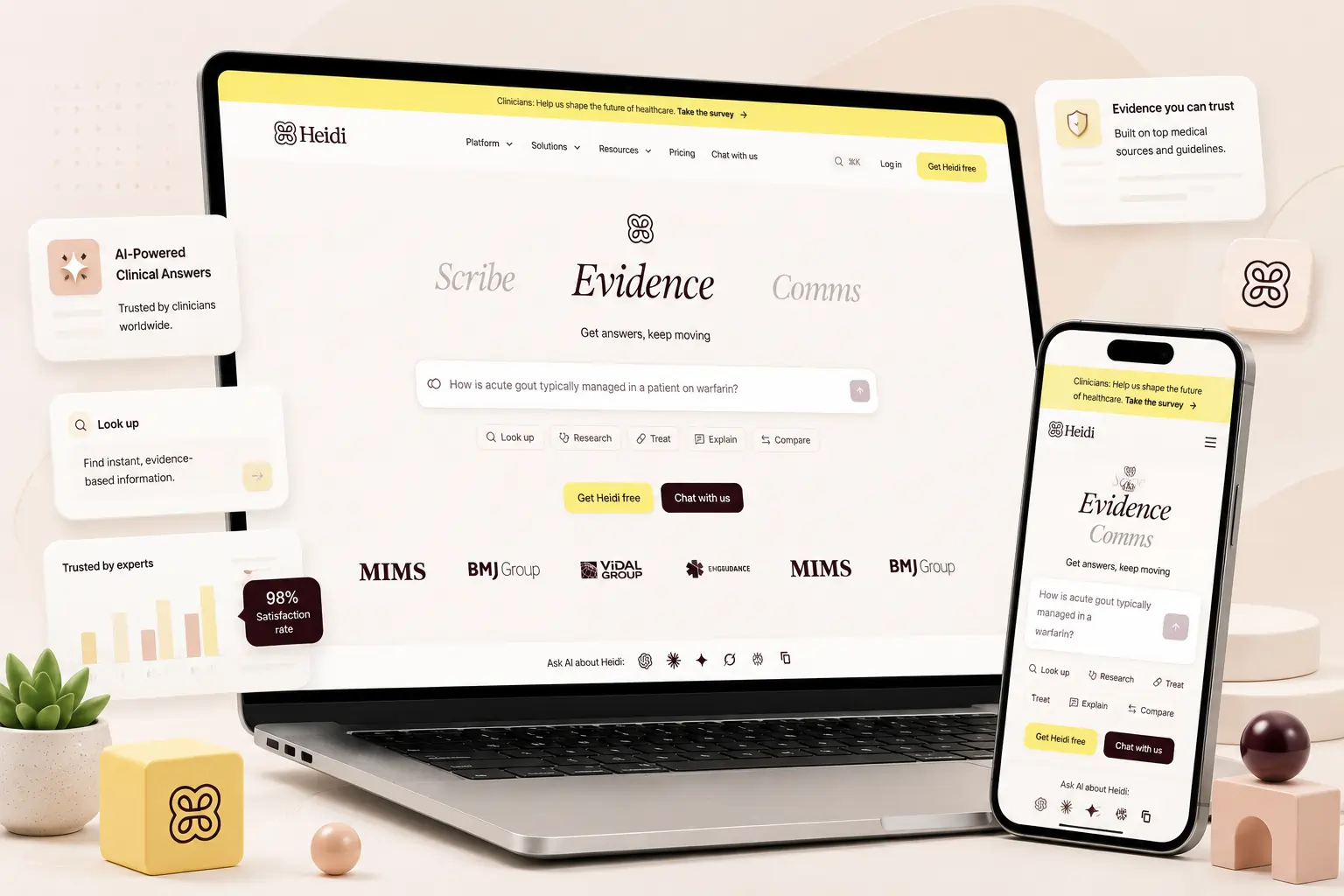
Heidi spans Scribe (notes, codes and follow-up), Remote (a clip-on microphone), Evidence (clinical reference with five search modes), Dictate, a desktop app for macOS and Windows, and enterprise tasks from care-gap outreach to referral triage.
Heidi HealthCase studyHealthcare AI · Clinical documentation
Heidi Health: relief in every visit
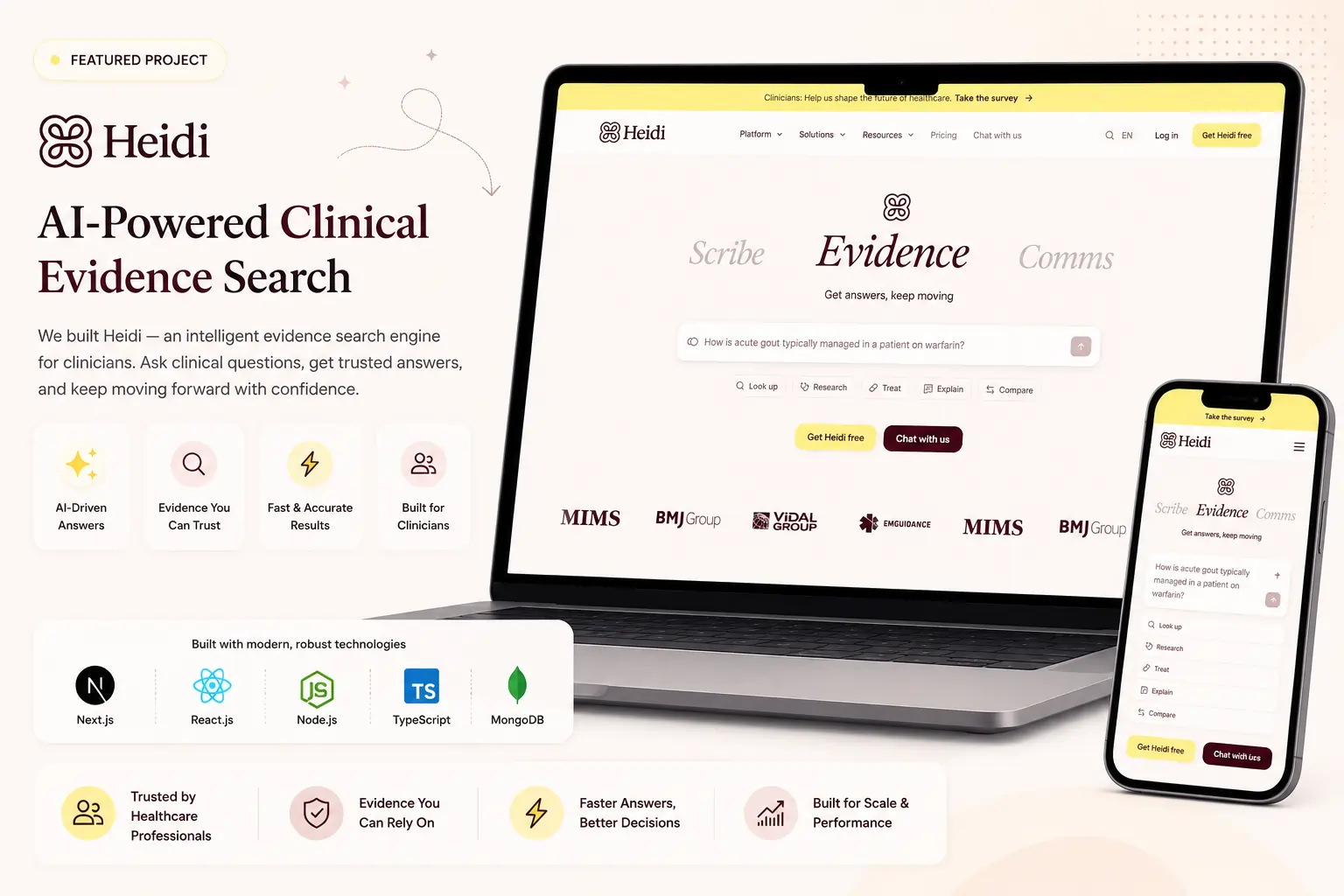
Heidi is an AI care partner for clinicians. It listens to the consult, writes the note, suggests the codes, answers clinical questions and handles the follow-up tasks. We designed and developed the platform with that calm built in.
2,730,854patient visits supported in a single week
10enterprise task types beyond the note
5privacy regimes covered: GDPR, HIPAA, AU/NZ, UK, Canada
5Evidence search modes, from look-up to compare
The brief
Clinicians are tired. The product had to feel like a deep breath.
Heidi’s promise is relief: going to lunch on time, going home on time. The experience needed to earn that trust before a single click.
Explain a broad clinical platform to individual GPs and to health-system buyers at once, while meeting the bar for privacy, accessibility and calm that healthcare demands.
- Two audiences: the clinician and the CIO
- Compliance content for five regions
- Product demos that never feel like hype
We designed and developed the Heidi platform on Next.js, React, Node.js, TypeScript and MongoDB: Scribe note generation, Evidence search, task automation and the region-aware compliance experience.
A visit, end to end
From first word to final follow-up.
Heidi isn’t one feature, it’s the whole visit. We designed it as a single line a clinician can follow, with each module sitting where it helps.
01 · Capture
Remote & Desktop
A clip-on mic that moves with the clinician, or the desktop app capturing telehealth audio straight from the call.
02 · Scribe
Notes and codes
The consult becomes a structured note in the clinician’s own template, with codes suggested alongside.
Look upTreatCompare
03 · EvidenceAnswers on tap
Clinical reference questions answered in the moment, with the sources shown.
04 · Tasks
The follow-up
Referral letters, patient summaries, refills and reminders, drafted and queued.
Heidi Evidence
Five ways to ask. One trusted answer.
Evidence lets a clinician look something up, research it, plan treatment, explain it to a patient or compare options. Each mode is tuned for its own kind of question, so the difference is obvious at a glance.
Sample questions and answers for illustration only. Not clinical advice.
Maximum daily paracetamol dose for an adult?Look up
H
For most adults, 4 g in 24 hours, taken as 0.5 to 1 g every 4 to 6 hours. Use a lower ceiling for low body weight, hepatic impairment or regular alcohol use.
SourcesMIMSBNF
What is the evidence for SGLT2 inhibitors in heart failure?Research
H
Large randomised trials show fewer heart-failure hospitalisations across both reduced and preserved ejection fraction, on top of usual therapy.
SourcesBMJNEJMESC guideline
First-line management of an acute gout flare?Treat
H
An NSAID, colchicine or a short oral corticosteroid course, chosen around comorbidities. Keep urate-lowering therapy going if the patient already takes it.
SourceseMGuidanceNICE
Explain HbA1c to a patient in plain words.Explain
H
HbA1c shows your average blood sugar over roughly the last two to three months, so one reading tells us how things have been going, not just today.
SourcesPatient leaflet
Apixaban vs warfarin for atrial fibrillation?Compare
H
Apixaban needs no INR monitoring and had less major bleeding than warfarin in trials. Warfarin stays the choice for mechanical heart valves.
SourcesVidalBMJ
Heidi for health systems
Beyond the note: ten jobs, handled.
For health systems, Heidi takes ten kinds of work off clinical teams, each handled as its own workflow.
Care gap outreach
Patient communications
Guideline adherence
Coding & CDI
Revenue leakage
Specialty pharmacy refills
Chronic-care RPM outreach
Pre-charting & visit prep
Repeat prescriptions
Referral triage
What we delivered
Calm, fast and clinically credible.
Twelve weeks of design and engineering on a modern JavaScript stack.
Scope of work
Design and engineering worked together, with each module shipped and reviewed as soon as it was ready.
- Scribe: consult capture to structured notes in the clinician’s template
- Coding suggestions and follow-up task drafting
- Evidence: five search modes with sourced answers
- Remote and Desktop capture experiences
- Region-aware compliance: GDPR, HIPAA, AU/NZ, UK, Canada
Next.jsReactNode.jsTypeScriptMongoDB
Product names, features and figures on this page belong to Heidi Health and are shown to explain the platform. DivyGfx designs and builds products like this end to end, from UX to full-stack development. Talk to us about yours.